
Someone recently asked me when the next Scholastic warehouse sale is scheduled in the area so here's the info:
Lewis Center
Read Street, 459 Orange Point Drive, Suite A, Lewis Center, OH 43035 (800) 557-7323
Thurs, 12/7/2006 - Fri, 12/22/2006
Dec. 7th 10 AM - 7 PM
Dec. 8th and 9th 9 AM - 5 PM
Dec. 11th - 14th 10 AM - 7 PM
Dec. 15th - 22nd 9 AM - 5 PM
Closed Sun.
For those you you who haven't been to a sale, the Scholastic Warehouse Sales are a great place to build up your book collection because everything is at least 50% off the Scholastic price. As usual, this sale is really designed to reward teachers and volunteers for their help selling books, but in the past they didn't seem to mind that I'm not a teacher. They do count homeschoolers as educators so some of you that teach pre-school at home probably qualify that way. You can go to their site for more information or to register early. When you register online they usually give you a coupon too.
Tuesday, November 07, 2006


Monday, November 06, 2006
Rules - by Cynthia Lord

Rules by Cynthia Lord is one of those books that I didn’t want to pick up because I thought it was going to be totally driven by its message. Instead it was one of those books that I read late into the night that left me unable to sleep because I couldn’t stop thinking about it.
Rules is about 12 year-old Catherine who writes rules for her autistic younger brother, David, to help him behave. She reasons that David doesn’t understand things they way most people do, he has to have people explain everything to him, thus the rules are necessary to help him learn things other people would naturally know such as, it’s fine to hug mom, but not ok to hug the clerk at the store.
Catherine is full of anticipation when she learns a girl her age will be moving in next door. She’s determined that they’ll become best friends, but a little worried that David will get in the way. Meanwhile she begins to make another new friend, Jason, as she waits for David during his occupational therapy sessions. Jason is paraplegic and can’t speak so he uses a book of words that he points to in order to communicate.
See, it sounds like a book trying to drill its message into your brain doesn’t it? But it doesn’t come off that way at all. The author carefully balances Catherine’s desire to be normal and her frustration with David with her love for David and the need every twelve-year-old has to be accepted. By the end of the book she learns the difference between rules and excuses.
As much as I enjoyed reading about Catherine’s relationship with her brother and her friends, it was her relationship with her parents that really got to me. Most preteens will be able to really relate to Catherine’s intense need for her parents attention when her parents are focused on other important things. Catherine could have easily come off as mean or selfish during certain points of the book, but Cynthia Lord does a wonderful job letting the reader understand her actions in order to balance things out, and I really appreciated that Catherine was a realistic kid, not a saint. I wasn’t surprised at all to learn that Cynthia is the mother to children, one of which is autistic, because I found myself often wondering how she could be so insightful about the familial relationships in this book.
-And for those of you that have read this book, I didn’t things Arnold Lobel’s Frog & Toad could be nearer and dearer to my heart, but after reading Rules it is.
Friday, November 03, 2006
Betsy Lewin
If you're in Columbus on Wednesday, November 8th and you happen to have some freetime, Betsy Lewin will be speaking at Cover To Cover and autographing books from 4:30 - 6:00. It's the perfect opportunity to get your copies of Click Clack Moo, Cows That Type or Dooby Dooby Moo signed.
December - Children's Poetry
We’ll be focusing on poetry for the month of December. Amy Hall will be hosting and she has selected The Random House Book of Poetry for Children for our reading. She also requests that you each choose a favorite poem (not necessarily from the The Random House Book of Poetry for Children) and bring the poem and a little bit of info about the author to share with us next month. Have fun browsing the poetry section at the library!
Wolves - by Emily Gravett

You might think I have a demented sense of humor for saying this, but Wolves is one of my favorite picture books of the year! Wolves begins with a rabbit going to the library to check out a book about wolves.
As rabbit begins to read the book and is drawn into it, the illustrations of the pages that rabbit is viewing in the book get larger and the reader's apprehension over what's going to happen grows until it looks like this (which sort of reminds me of how the illustrations in Maurice Sendak's Where the Wild Things Are grow as the story progresses and Max becomes wild).

The text on this page says, "Wolves eat mainly meat. They hunt large prey such as deer, bison and moose. They also enjoy smaller mammals, like beavers, voles and . . . "
You guessed it, "rabbits." I love this illustration because it's not too scary, but it clearly communicates what happened to rabbit.

At this point I know some of you are thinking, "What? This is a children's picture book?" and that is probably why the author included this note on the next page, "The author would like to point out that no rabbits were eaten during the making of this book. It it a work of fiction. And so, for more sensitive readers, here is an alternative ending." After which, we see this illustration with an explanation that this wolf was a vegetarian who shared lunch with rabbit and they became best friends.

I think most kids will find this book very funny. I thought it was rather clever, but the element of the book that I fell in love with was its design. The text of the book doesn't stand alone, it's the pictures that develop it further, as they should in every good picture book. And they make such wonderful use of white space (or cream space in this case) which is rare in the overstimulating picture books we often see these days. The book designer paid attention to every possible detail, even the publication information was formatted to look like a part of rabbit's story. The critical praise on the back cover is all made up to tie in with the story and rabbit puns abound, for example, "'A rip-roaring tail.' - The Hareold"
It's too bad that the author/illustrator is British because I think this book would have been a big contender for the Caldecott Medal, which tends to reward books that challenge the normal format of picture books and have engaging illustrations.
Wednesday, November 01, 2006
Fall Book Review
For those of you in Columbus, I just heard that Cover to Cover Children's Bookstore's fall book review is coming up. This is one of my favorite events of the year because they staff always has such honest and insightful things to say about the new books out there. Plus it's a great way to start your Christmas shopping because the attendees get an extra discount plus a bag of goodies.
They have two sessions so hopefully you can make one of them.
Tuesday, November 14th from 6:30 - 8:00 p.m.
Thursday November 16th from 6:30 - 8:00 p.m.
They have two sessions so hopefully you can make one of them.
Tuesday, November 14th from 6:30 - 8:00 p.m.
Thursday November 16th from 6:30 - 8:00 p.m.
Thursday, October 26, 2006
River Secrets - by Shannon Hale
 Some book club members recently asked me when the next Shannon Hale book is coming out and I realized that I forgot to review River Secrets. River Secrets is the third book in the Goose Girl series about the people of Bayern. This book follows Razo, a boy Isi met in the first book when she worked as a Goose Girl. In an effort to keep peace with the kingdom of Tira, Bayern sends an ambassador accompanied by Enna (a fire-speaker) and a group soldiers. Razo is happy to be included, but he is surprised to be chosen to go when he knows he isn’t a very strong soldier. Razo may be the smallest and the weakest, but he was chosen for the strengths he didn’t know he had and was soon to discover. On the journey he discovers a charred body and doesn’t know if Enna is burning again or if someone wants people to suspect that she is. Through his investigations he’s easily able to make friends with many Tirans high and low in stature and he becomes the best hope the people of Bayern have to keep peace.
As with her other novels, Hale continues to address the issues of classes, war, and prejudice in a way that’s not too threatening to her young audience. Underdogs will relate to Razo and root for him to succeed on his mission and succeed in love.
The romance wasn't as appealling to me as the relationships between Finn and Enna and Isi and Geric, but I think Hale got in right because Razo isn't as mature as the other characters and isn't ready for too much in the romance department.
I’m already wondering when the next book in the series will be released. I can’t wait!
Tuesday, October 24, 2006
The Dog in Chris Van Allsburg's books
Awhile ago the Blue Rose Girls posted about finding the dog in Chris Van Allsburg's picture books. I did a project on Van Allsburg a long time ago and I thought some of you might like this key. I haven't added his newest book Probuditi, but if you're having trouble finding the dog it appears as a teapot on a shelf. I think if you click on my key you might be able to see a bigger copy, but if you want me to email you a copy just leave me a comment with your email address.
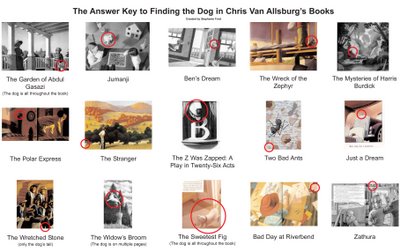
I also had to share this quote that I think explains a lot of Van Allsburg's work.
"Lucky are the children who know there is a jolly fat man in a red suit who pilots a flying sleigh. We should envy them. And we should envy the people who are so certain martians will land in their back yard that they keep a loaded Polaroid camera by the back door. The inclination to believe in the fantastic may strike some as a failure in logic, or gullibility, but it's really a gift. A world that might have Bigfoot and the Loch Ness monster in clearly superior to one that definitely does not."
- Chris Van Allsburg
Thursday, October 19, 2006
Vote now!
The Cybils are open for voting so head on over and nominate your favorite books. Don't forget to check out the rules before you vote!
Yellow Star - Jennifer Roy

I’ve been meaning review this book for awhile, but don’t think for a moment that I put off reviewing it because it’s not great. This book was spectacular.
The novel is based on the true story of Jennifer Roy’s aunt Syvia who was one of twelve children who survived the Holocaust in the Lodz Ghetto. It beings in 1939 with 4 ½ year-old Syvia describing the yellow star sewn onto her coat. It follows Syvia and her family as they are forced into the Lodz Ghetto and continues to describe their life until the end of WWII.
Holocaust books for middle grades can be very difficult because they shouldn’t hide the truth, but they shouldn’t be overly graphic and gruesome. Yellow Star walks the fine line perfectly because it’s told from the point of view of a young girl who didn’t always understand the truth and her parents and older sister protected her as much as they could. To support Syvia’s story and prevent any confusion, her story is interspersed with a few brief historical descriptions of the war and the novel contains a detailed timeline at the back of the book.
There are plenty of sad moments, but a few joyful moments too. Since the book begins with the statement that Syvia is one of the children who survived, the readers are spared some anxiety.
Yellow Star is also a good example of one of the few books with a story that is strengthened thru being told in verse. The simplicity of prose matches the descriptions young Syvia lends credit to her perspective as a child.
At the Boston Globe-Horn Book Awards, Jennifer Roy said her generation was told to “always remember”, but they weren’t told what to remember. In the foreword she said he father was also a Holocaust survivor, but he never talked about it and when he died, his history was lost. I’m certainly glad she was able to preserve Syvia’s experience before it grew too late. Her beautiful story will help children relate to an event that seems so inexplicable to us all.
Tuesday, October 17, 2006
The Cybils
Sometimes when a new children's literature book award is announced I'm pleased to hear the winners, but often I find myself thinking, "What!?!?!?!?" Well now the children's literature bloggers are creating a new award, and we get to make the nominations and the final decisions. The award just recieved its new name today, The Children's and YA Bloggers Literary Awards, or to keep things simple, The Cybils.
Read all about the rules here on Big A Little a.
I get to be on the nomination committee for middle grade fiction, which is headed by Fuse #8. I can't wait for discussion to begin!
If you'd like to be a part of things it's not too late. There are still some committee positions open!
Read all about the rules here on Big A Little a.
I get to be on the nomination committee for middle grade fiction, which is headed by Fuse #8. I can't wait for discussion to begin!
If you'd like to be a part of things it's not too late. There are still some committee positions open!
Framed - by Frank Cottrell Boyce

From the Publisher
Dylan Hughes is the only lad living in his tiny Welsh town. He helps out in his family’s failing garage, managing the petrol log and keeping track of every single vehicle -- including the mysterious convoy of lorries that trundles up the misty mountainside one day. Local gossip soon sniffs out that the slate mines are being used to harbour a valuable collection of artwork, but Dylans more interested in Renaissance inspired Ninja Turtles than the real thing.... But then Dad leaves home, leaving Dylan man of the house and boss of the struggling business. A masterpiece worth a mint might be just what his family needs.
Wow! Just wow! Can I leave it at that? No? Ok, I’m dying to talk to someone about this book anyway. I have finished several books that I need to review, but as soon as I finished this one last night, I knew it had to take priority.
In Framed, Boyce explores how art affects people much like he explored how money changes people in Millions and the result is magnificent. Both books have fictional premises related to real events that make them seen plausible. In Framed, the National Gallery moves all of its painting to be stored in an abandoned mine to protect them after flooding in London makes them hard to insure in the city. The plot might sound crazy until you learn that during WWII the paintings from the National Gallery actually were packed up and stored in a quarry by a very small town. When Boyce learned about the evacuation, he found himself wondering how the world-famous art might have affected the townspeople and thus Framed was born. Dylan’s town, Manod, actually is so far behind the times one might think the book takes place during WWII if it wasn’t for a few modern references here and there like the Ninja Turtles, the movie The Italian Job, and text messaging.
A few parts of the book did seem a bit odd to me, but with Boyce I’ve come to expect a bit of unexplained quirkiness. The beauty in the book is the inventive characters Boyce creates. There’s not a boring person in the book, and I wouldn’t in a million years have guessed the wonderful ways different paintings would change the characters.
I think most people will love this book, but art enthusiasts will especially appreciate Boyce’s illustrations of the power that a few paintings can have when a handful of people have a chance to connect to them.
I think we need to nominate Frank Cottrell Boyce to Fuse #8's Hot Men of Children's Literature series. Some people probably thought Millions was just a fluke and Boyce is a movie man, not a real children's book author, but after reading Framed I don't think anyone can deny Boyce has established himself as an author, and I hope there is much mor to come from him.
Monday, October 16, 2006
The House of Scorpion - by Nancy Farmer
 From the Publisher
Matteo Alacran was not Born; He was Harvested. His DNA came from El Patron, lord of a country called Opium -- a strip of poppy fields lying between the United States and what was once called Mexico. Matt's first cell split and divided inside a petri dish. Then he was placed in the womb of a cow, where he continued the miraculous journey from embryo to fetus to baby. He is a boy now, but most consider him a monster -- except for El Patron. El Patron loves Matt as he loves himself, because Matt is himself. As Matt struggles to understand his existence, he is threatened by a sinister cast of characters, including El Patron's power-hungry family, and he is surrounded by a dangerous army of bodyguards. Escape is the only chance Matt has to survive. But escape from the Alacran Estate is no guarantee of freedom, because Matt is marked by his difference in ways he doesn't even suspect.
For those of you that missed out discussion at book club, I wanted to share my thoughts on this one. As I was halfway through the book, my friend Katherine remarked to me that she felt the same way reading this book as she felt reading Ender’s Game by Orson Scott Card because she felt sorry for the main character who was picked on and disliked by almost everyone around him. I didn’t think much about it until I finished the book and looking back I’m surprised by all of the similarities between The House of the Scorpion and Ender’s Game. On the surface both books seem to have such different plots, but they both boil down to so many of the same main elements. Ender and Matt both stand out as different from everyone around them, but neither of them fully understands why everyone treats them differently. Both are being raised to fulfill important futures that no one bothers to explain to them. Both are relatively uncared for and have potential for evil, but they are each saved by a young girl who loves them and wants them to turn out to be good. After Ender is sent off to school and Matt is sent to a work camp they are both tortured by the other boys, but they earn loyal followers after they prove their bravery and strength. With the help of their new friends, both boys are able to alter the future of the world and accomplish almost impossible tasks.
For all of their similarities, I still felt like Scorpion was an original works the sci-fi fans will love.
Can you think of another book that would fit in with these two? I can’t.
Friday, October 13, 2006
Penny From Heaven - by Jennifer L. Holm
 The next few reviews will probably have summaries from the publisher to save me a little time as I try to catch up.
From the Publisher: It's1953 and 11-year-old Penny dreams of a summer of butter pecan ice cream, swimming, and baseball. But nothing's that easy in Penny's family. For starters, she can't go swimming because her mother's afraid she'll catch polio at the pool. To make matters worse, her favorite uncle is living in a car. Her Nonny cries every time her father's name is mentioned. And the two sides of her family aren't speaking to each other!
EVERYONE seems to love this book. There are glowing reviews everywhere and if you pick up this book, you will probably love it too so I’m almost embarrassed to admit that I did not love Penny From Heaven. Here’s where the confession gets even more shocking; I think it’s because it sort of reminds me of Anne of Green Gables, which I also did not enjoy (pause for gasps). Ok, let me explain; I know Anne is beloved by many, but I just cringe thinking about all of the crazy situations a “good” kid got herself into. Reading her story I constantly wanted to yell at her to stop what she was doing because I loved her, and I couldn’t stand the anticipation of the trouble she was going to get into. My relationship with Penny was much the same. The story, like’s Anne’s, wasn’t really plot driven, it was more of a slice of her life. Penny kept doing things that I knew would not end well, and I wanted to stop reading to avoid getting to the trouble that I knew was coming. Oh Penny why do you always have to go along with Frankie’s crazy plans?
It didn’t help that I was listening to Penny From Heaven in my car over the same few days that I was reading the Loud Silence of Francine Green by Karen Cushman at home and since they were set during the same time period and about girls the same age, I kept comparing the two and I related to Francine a lot more. I also felt like I picked up a lot more knowledge about the time period from The Loud Silence of Francine Green so readers wanting to pick up more of a sense of how kids might have been affected by what was going on at the time, might prefer The Loud Silence (although they will learn from Penny From Heaven that some Italian Americans were imprisoned during WWII because some Americans thought of them and the enemy).
And even though I haven’t seen it in anyone else’s review, the prominent stereotypes of Italian Americans in Penny From Heaven bother me quite a bit. Of course Penny’s Italian grandmother has lived in the United States for ages, but hasn’t picked up much English and spends all her time cooking and takes joy in trying to fatten her family up. She’s extremely emotional and always fighting with her daughter-in-law or crying when someone mentions Penny’s father. The character that really bothered me was Penny’s cousin Frankie, and Italian American kid whose dad was in prison who just wanted to grow up to be a gangster and spent all his time reading about them and scheming up plans for his own crimes. Really, did the book have to go there? Do you know a lot of kids who want to grow up to become a famous criminal?
All of that aside, Penny's complicated family relationships are truly touching and I put down the book feeling happy in the end as I suspect many of you will too.
Wednesday, October 11, 2006
November - Short Stories
Our November meeting will be a little different than usual. We'll be meeting at Jessica's to discuss short stories and we'll even read a few aloud. Jessica would like you to read the following:
Best Shorts, Selected by AVI
Newbery Medal-winning author Avi has selected short stories from the past and present in this entertaining collection for young readers. And whether you begin by reading alone or reading aloud, these stories are some of the very best to share. Featuring loyal pets, rogue waves, ghosts who use cell phones, and young people caught up in events beyond their control, these stories are written by some of the most entertaining and esteemed authors of children"s literature. They will have you savoring a quiet moment by yourself, talking during dinnertime with your family, and laughing in class with your friends. Though it may take only a few minutes to read, a terrific short story can take you on a long journey. Are you ready for the trip?
Unreal!: Eight Surprising Stories, by Paul Jennings
Two weird, chilling, and wacky story collections from the inimitable Paul Jennings. "Jennings has found the perfect formula for the scary and supernatural sprinkled with just the right touch of humor. . . . Don't miss out on the fun here".--School Library Journal, starred review. (If you can’t get a copy of this, or it’s companion book, Uncanny, try to read any other of his short stories for children.)
Playing Catch-up
There are several reasons I haven’t been posting much here. It’s partially due to having three blogs, and it’s also partially due to being behind in pretty much every area of my life, but it’s mostly due to the fact that I read I few books that I didn’t like, and I wasn’t sure whether or not I should review them. Lucky for me, the children’s lit blog world has been discussing whether or not children’s literature bloggers should post negative reviews (read Jen Robinson’s take on it here and Fuse #8's opinion here). The discussion got me thinking about where I stand, and I think I’m finally ready to start reviewing again.
Here are my thoughts. I originally started this blog a year and a half ago to keep my fellow children’s literature book clubbers updated about book club. Eventually, I started posting my personal book reviews here instead of my personal blog because I figured the book club members were interested in them and any of my family and friends that were interested could easily read them here too. I am thrilled that other people have started reading this blog, but I still primarily review books here simply to let my friends know what I think about them. If a book I recently read came up during a book club meeting, I wouldn’t feel bad about saying that I didn’t like it, and why should that change on this blog?
Hopefully everyone reading this blog knows that I strongly believe every reader connects to a book differently because they bring different experiences and knowledge with them so each person has a unique interaction with each book they read. I’m always so excited to go to book club and hear that someone else had a completely different reaction to a book than I did because I often learn so much from their explanation of why they felt the way they did about it.
While I hate negative reviews that basically say something to the gist of, “I think this books sucks. Don’t read it.” I find negative reviews that explain the reasons for the reviewer’s dislike so interesting. In fact, a good friend recently told me that she’s never liked the book Stargirl by Jerry Spinelli, which happens to be one of my favorite books and I immediately wanted to know more; I wanted to hear why, and I was glad I listened and learned, even if I didn’t agree.
Sometimes I read a negative review and think, “Yikes, I already know this is a book I won’t like. Thanks for the warning.” Other times I read a negative review, and think I might actually like a book for the same reasons a reviewer hated it. I recently heard from two friends who read a review I wrote about a book that I didn’t particularly like and they both went right out and picked the book up because the review made them interested in it, and I think that’s the way it should be.
I wish there was a book God out there that would send me a message every time I finished a book to let me know which book I should pick up next because I will absolutely fall in love with it, but there isn’t. Instead I’ll have to browse on my own and use my good judgment along with a little help from some reviewers and friends whose opinions I’ve grown to respect and appreciate.
Besides, I need to pick up some books I don’t like once in awhile or at least read about them because they make me appreciate other books all that much more.
Friday, September 08, 2006
New Moon - by Stephenie Meyer
 Let me start off by saying that if you haven’t first read Twilight and then read New Moon, DO NOT CONTINUE TO READ THIS POSTING!!!!! I can’t stand to spoil one bit of the surprise for you. Do not continue, rush yourself to a library or bookstore right now!
We discussed Twilight at book club last night and it was killing me not to say anything about New Moon because it answers so many of the questions book club members had about Twilight. I flew through this book just as quickly as Twilight (although I did miss Edward in the middle). Since you’re only reading this if you’ve read Twilight, I’m not writing a summary, I’m just going to dive right in. I really wondered how Meyer, a Mormon author, would continue Bella and Edward’s love story while keeping it relatively clean. As much as I missed Edward in most of this book, keeping him away from Bella for most of the book was definitely a good solution.
I have to say that I loved the comparison/contrast of Bella and Edward to Romeo and Juliet and how they developed to be more than infatuated teenagers. The comparison also fed right into the way Bella felt when Edward left her. It explained why she became so reckless. Meyer did a wonderful job of describing Bella’s depression. The chapter heading of the names of months with blank pages was brilliant.
I was so happy to learn more about Jacob. Stephenie Meyer posted outtakes from New Moon on her Web site and one of them is from Meyer’s first draft of New Moon in which Bella never finds out from Jacob that he’s a werewolf. As much as I missed Edward during this part of the book, when I read the outtake I realized I wouldn’t change the final version. Bella’s struggle over whether or not to give in and become romantically involved with Jacob is so interesting. If your true love was gone from your life forever would you settle for someone that you really cared about, but didn’t love if you knew it would make them happy and keep you from losing your best friend? And by the way, WEREWOLVES!?!?!?!? First I have to admit that I really enjoyed a teenage vampire romance novel, and now I have to admit that I like a teenage werewolf/vampire romance novel. Try explaining that to someone and still get them interested in reading the book, but the beauty of Stephenie Meyer’s writing is that it’s so vivid and it draws you into the story so that by the time you get to the werewolves, you absolutely can’t put the book down because you’re already hooked.
I was completely surprised by the ending. I think it’s very out of Bella’s character to not jump at the chance to marry Edward when she wants to be with him forever and she doesn’t even like him to leave her side. I think maybe that was a little poor character development because it could have been clearer earlier in the story that because of her experience with her parents’ divorce she was anti-marriage. Instead Bella seems pretty happy that her mom was remarried and happy.
I was also surprised that Meyer covered as much time as she did in this book. It started several months after the first book and went through most of her senior year and Meyer has already said this will be an ongoing series, not just a trilogy. A lot of authors would want to keep Bella in high school as long as possible, but Meyer seems to have no fear of moving on and I can’t wait to find out what happens next.
For those of you in Ohio or Utah, Meyer will be touring in the area soon. Check out her tour schedule here.
October Books
We’ll be meeting at Tara’s in October and we are reading books that we selected last night at book club. Here’s the list:

New Moon by Stephenie Meyer

The House of Scorpion by Nancy Farmer

Midnight for Charlie Bone by Jenny Nimmo

Shakespeare’s Secret by Elise Broach
Since we had such a hard time narrowing the list down, we will be reading a few of the other suggested books in January under the theme of books about thieves.
New Moon was just released so it will be hard to get a copy. Reserve a copy at the library ASAP and if you own a copy or get a copy from the library, please pass it around to the rest of the group.
Happy reading!
Wednesday, September 06, 2006
My Life Starring Mum - by Chloe Rayban
 13 year-old Hollywood Bliss Wintermann tries to have a normal life at her Catholic boarding school where only her best friend knows that Holly’s mother is singing superstar Khandi (think Cher or Madonna). Khandi yanks Holly out of school and deposits her in a suite in the posh hotel she’s staying in London. She tells Holly that there’s been a serious threat so she wanted Holly near her because the school couldn’t provide enough security and she also says she wants to spend more time with Holly, but Holly’s not too surprised when it seems her mother forgot she exists and hasn’t even bothered to set up tutors. Holly has to make appointments to see her mom and is thrilled when she gets her mother to agree to set up tutors. She isn’t thrilled when dancing and singing tutors show up.
I was surprised that it took quite some time for Holly to realize that Khandi was using her and trying to turn her into a superstar too. Although Holly is witty at times, I wanted more emotion from her character. She never lets her mom have the honest criticism she deserves, and I don’t know many teenage girls who would handle things that way. The most interesting part of the book is Holly and Khandi’s relationship and the author spends a lot more time focusing the posh life than the real issues at hand. Although Holly doesn’t become a mini-Khandi in the end, she also doesn’t do much to improve her relationship with her mother. Maybe that means there’s a sequel in the works.
I was a little bored at times, but some pre-teens may enjoy reading about Holly’s disdain for the life of the rich and famous.
Subscribe to:
Posts (Atom)